Saturday, May 3, 2008

Two days in Bologna


From left; Lorenzo Bianchi, Antonio Martino, Greta Barbieri and Amin Wahidi photo by: Mattia Baglieri

I had a short trip to Bologna where I spent about two days.
Actually I was invited there by YAP Bologna Branch (Youth Action for Peace) which is an international movement for peace and conducts social- cultural – artistic and awareness programs in different countries including Italy.
I was invited there for a conference about Afghanistan.

Conference about Afghanistan; current situation, cultural activities, and freedom of speech

The conference took place in Political Science Department on Strada Maggiore. In this conference there were two other speakers too;

Lorenzo Bianchi a famous Italian Journalist working for QUOTIDIANO NAZIONALE
Antonio Martino an Italian documentary filmmaker in Bologna

The main issues discussed in this conference were; challenges of freedom of speech in Afghanistan, the re-empowerment of the fundamentalists in the branches of the government and the administrative corruptions in government of Afghanistan
The program went on very well and present people in this conference had some questions and were answered by the speakers at the conference. As my Italian is not very good I spoke in English and there was a professional translator “Greta Barbieri” who did a really good job.

Meeting new people:
In addition to meet some interesting people there; Lorenzo Bianchi, Isabella Nicoli, Francesco, Aura, Mattew, Angelo, Antonio Martino, Sara, Greta and Mattia I have had a chance to see some interesting places of Bologna by the help of two friends from YAP Angelo and Mattew.

Short film screening:
Again in the evening there was a chance to screen two shorts which we screened before in Milan.

Two petty things:
On the second day, before coming back to Milan as I had a chance to see some of the places like libraries, universities, city towers, churches, I saw a man in the main square of the city (Piazza Maggiore) like giving speech. He had a bicycle, a small stool to sit on and some newspapers and was talking to people and discussing the issues of newspapers with them, and there were people who took part and they also discussed their opinions about the current situation of the country, about politics and the politicians etc.
It was very interesting for me when I knew that this man does not have any work but every day brings newspapers and begin discussing about the current affairs with different people and his audiences are young and old. Every one is given a chance to talk and just share and exchange their ideas which is actually like a public awareness program.
I wish this could happen in Afghanistan that one day any one can discuss issues of political, religious and current affairs in public with the person without fear, censorship and intimidation that is the real democracy and freedom of speech.

The second thing that I wasn’t expecting at least in Italy was a little censorship in my interview in two papers of Bologna and Milan.

QN IL Resto del Carlino (Bologna) 23 Aprile 2008 Anno 123-Numero 97
QN IL Giorno (Milano Metropoli) 23 Aprile 2008 Anno 53- numero 97

The interview was done in English via email by Mr. Lorenzo Bianchi who is a nice man with a working experience of my age, and then when I read the Italian version published in Italian papers I did not find a part which then I realized was censored and that was about my current situation;

lorenzo Bianchi: Did you get the political asylum from Italy?

Amin Wahidi: Not a fully political asylum yet which I have asked for it and it is in process but all things work here very slowly.
For the moment I have received a short term permission of stay, which I think will be renewed after it expires and then the decision is in the hand of the government of Italy.

I hope the government of Italy would consider a difference in between the political asylum seekers whose lives are in danger because of their thoughts and their activities and the labor and economical immigrants.

To see the program in YAP website

To see the interview in Italian

Wednesday, April 16, 2008

Let’s not just say we support freedom of speech in Afghanistan, let’s do it!

Basir Ahang is another Afghan journalist who has recently suffered death threats and been forced to flee the country.

Recently we learned that Basir, a 27 year-old Afghan journalist who worked for “Farda Radio” and sometimes for the Italian Paper “La Republica,” was not missing as previously thought. In reality, he has had to flee the country because of the death threats he and his family have received from the Taliban and other extremists in Afghanistan.

We must condemn these death threats. They are one way the Taliban targets the intellectuals and young media activists of the country in addition to their killings of many innocent civilians on daily basis. We would like to express sympathy with this latest target of terror and wish him safety. We have heard he has come to Italy; we hope that he will not give up his efforts working for freedom of speech wherever he is. That is the most important thing for his country.

While Parwiz Kambakhsh has not been released yet, he has been shifted to Kabul to await further trial. Ali Mohaqiq Nasab, the secular Afghan scholar, women’s rights activist and writer-journalist, who was arrested and put on trial in 2005 for voicing controversial ideas about Islam, has recently been arrested by authorities in Iran without any clear reason. There has not been further news about him since then, though the Afghan Government Foreign Ministry, through its diplomats in Iran, have begun to talk with the Iranian government about his release.

A few months ago, Hanif Elham, the active journalist-producer and text editor for Ariana Radio and Television Network, was threatened with death by the Taliban. The threats came in response to his daily radio program, in which he revealed the crimes and genocides of the Taliban throughout their history.

This shows the worsening of the situation for free media activists in Afghanistan. There are problems and pressure from multiple sides: the Taliban, the former Jihadis, the warlords and the governmental institutions have all played a part.

Though some people may believe that the escaping journalists are in fact abandoning their country, we should keep in mind that the media and journalists are the eyes and the ears of the society. When the government not only fails to guarantee the journalists’ safety but creates pressures and obstacles for them, it is the responsibility of their country to show sympathy for and support those who serve as their eyes and ears. It is also the responsibility of the countries where they flee for protection to care for them.

The people criticizing the fleeing journalists should remember that if they did not escape the country would likely be killed. They should consider the close relationship of the government to the Taliban, and the advances the Taliban have made in the government through the Ministry of Information and Culture. Instead of defending the rights of journalists, this ministry now makes traps for them.

Those criticizing the journalists should remember the fates of those like Parwiz Kambakhsh, who are jailed or delivered directly to the Taliban. They should remember that, if a media activist is jailed by the government, there is still some hope or possibility of his release through the intervention of international journalistic organizations—but who will release them from the hands of terrorists whose actions are not based on any human logic? Who will ensure his life when even the presidential palace in the center of the capital is not safe from the Taliban and Al Qaeda’s attacks, even though that government is attempting to compromise with them?

No matter who he is, someone who is punished or threatened for speaking freely has to be assured safety. He has to be supported and protected by any country he comes to for help. That is how freedom of speech is promoted and defended.

In defense of the decisions by many journalists to flee Afghanistan, I would like to remark that, in a country where ignorance is waiting for any chance to spread again; where any knowledge is condemned easily by a Fatwa from Mullahs reliant on a flawed understandings of Islam; where such leaders maintain the trappings of Islam, such as growing beards and reciting the Quran, without knowing and acting on what it says; where such men pray without knowing what they are saying in their prayers; where people are being misled through their emotions and sensations in the name of religion; where one sees violence instead of peace and love in all corners; where the border between life and death is very narrow, narrower than a hair; where you find mines, bullets and bombs in the spring instead of blooms; if the people in such a country are not educated about current affairs by the media and journalists that are the eyes and ears of the society, will the existing corrupt government function the way people want?

In a situation like this, if the journalists are not protected, the result will be a society blinded and suffocated with unheard voices.

The day will come when there will be no threats and intimidation against journalists or civilians in Afghanistan, because there is always a light after any darkness, but it takes time. It will require more struggles and more solidarity from the people with the media. They must ask their government to provide for the protection of journalists and media activists.

Edited by Nathan Hartle

Tuesday, April 15, 2008

One week of anguish


The pen in my hand doesn’t move to write, my hand doesn’t have the energy to pick up the pen and my brain doesn’t work properly.

All I think about is negative things. I feel I more pessimistic now than at any time before. I am to be evicted from the center where I live, having reached the six month limit allowed for residents. I may end up sleeping on the streets of Milan; therefore every minute is every important. Important because this is the hardest time in my life, important because I can feel and imagine all the others who do not have homes to go to. I can feel and imagine all the poor of India who are born in the streets of Bombay, grow up there and finally die there. But I did not start out like them; I was not born on the street and never had to sleep on the street before coming to Italy.

I hope you will forgive me if I am writing these paragraphs messily, or am not focused. It is not my fault that my current situation is like this. I am living in Milan, one of the biggest cities in Italy and a candidate for World Expo 2015.

I haven’t explained to you the main reason for my stress this week. This is a week which may be the beginning of a worse time—who knows except God?

It has been a week in which I have counted my every minute and every hour. Soon will come that day, the day when I will experience the worst moments of my life. On the other hand it is interesting, and maybe funny, that it is the third of April. This will be the final date of my stay in the refugee center in Milan, and then I will have to find somewhere else to sleep. I am supposed to sleep on the streets? I do not have any means of support or any work to do in my current situation.

These days, when friends write me emails or make me phone calls to ask how I am doing, I am not able to answer them properly. This shows how confused I am these days.

This is not the only negative effect of my current situation. My pen does not move to fill a white page, all the things I was thinking of doing are suspended. My creativity is almost buried under the weight of worry; of thinking about how to live and how to stay alive. Thinking about how to stay alive in Milan is the only thing in my life, therefore I haven’t been able to go to my Italian classes either these days.

I remember a few days ago when I was walking on the streets of Milan and was thinking only of which places I would use as shooting locations for my next short, which I have already written here in Milan. But these days when I pass by these places I am thinking of which ones to use as my real-life dwellings when I am forced into the streets.

Although I have asked the refugee office of the Comune di Milano to give me another place to stay until I get the appropriate documents and permits to remain in Italy, I have received no answer.

I think there will be many more people like in my situation soon, as one of the dormitories in Via Barzaghi was closed down by the authorities on the 31st of March. They reasoned that it was just an emergency dormitory for winter. Many people had to sleep on the streets.

Seeing my own situation and that of other people sometimes pushes me to stand for up them and help their voices reach the authorities and rest of the world.

While there are many big billboards advertising Milano Expo 2015 everywhere in the city, I am encouraged to go to the bottom layer of the city and expose the real face of Milan: the life of the many political refuges and asylum seekers, homeless in this big commercial city of Italy, and forced to sleep on the streets.

What is both sad and funny is that, unbelievingly and unwillingly, I feel regret. Why I am trying to be writer, and why I am writing? Why is everything meaningless here in this city, and why doesn’t the government care about the political refugees? Will anyone hear my voice?

Different questions come to my mind when I look at the hundreds of artistic landmarks in the city: the churches, the private buildings, the museums, the sculptures and many other works of art. I remember reading somewhere that more than fifty percent of the world’s art is located in Italy. This shows that Italy is a country that has grown many arts and artists and that has had a long relationship with the arts.

In a short walk towards the Duomo, I see the street musicians and the street performers, who seemed strange to me when I first saw them. While some of them were truly artists and played or performed very well, I was wondering at how poorly they were treated. Some say it is just a custom to be a street musician, some say it is a normal thing to be a street performer and some say that because they are poor or homeless they have to earn money this way. For me the worst of all was getting glimpses of the life of the old fat man playing accordion, whom I saw almost any time I went towards Castello from Duomo. These days, when my own situation is more uncertain than it was a few months ago, I can understand them more easily. When I see them, I can imagine how difficult life is in Italy for artists, writers, journalists or filmmakers.

The only question that stays with me is: why is Italy, the land famous for arts and artists, not treating them well? But I can’t find the answer by myself.

Anyhow, I look forward to seeing if the Comune di Milano is going to take care of my fellow political refugees and I. If not we will have to show the world THE REAL MILANO EXPO 2008: the true story of the political refuges and immigrants in the bottom layers of Milano.

And through this MILANO EXPO we will thank the Comune di Milano for its hospitality for the political refugees in this city.

Thursday, April 10, 2008

News from DeeDeeNow Cinema Productions

News from DeeDeeNow Cinema Productions

A night with Afghanistan in Milan; The smaller version of a week with Afghanistan in Milan – Italy

“A night with Afghanistan” is the title of a one-night screening of two short films from Afghanistan in Milan, Italy that was organized by Civil Services International, ASRI and Amin Wahidi on April 4 2008. “Treasure in the Ruins,” a short fiction by Amin Wahidi, and “Lima,” a short documentary by Mehdi Zafari, were on the program.

The audience of about seventy included cultural activists, cinema students, political science students, members of organizations working for refugee rights, and Afghan and Iranian refuges. There was a break for discussion and Q&A by the between the audience and Amin Wahidi after each film.

The main subjects were, current cultural activities in Afghanistan, freedom of speech, obstacles and challenges, efficiency or inefficiency of Western democracy in Afghanistan, and Afghanistan’s future.

Both films depicted the current situation Afghanistan. “Treasure in the Ruins” addressed the direct and indirect effects of war, of poverty and child labor, corporal punishment in schools, the lack of childcare and supervision, and the shocking state of the remaining ruins of the war. Who will take care of these war-orphaned children who have not shelter or guardians is the main question this short film addresses.

Homa is a young girl with a brother and sick mother in Afghanistan. She weaves carpet and she goes to school. Every night her mother tells the children a story so that they do not sleep and weave more carpet. Hearing one story Homa decides to go to the ruins and find “treasures” there in the ruins of Kabul but what all she finds are the symbols of war and destruction. Finally her mother dies. Remaining alone with her brother Homa burns and buries all she has found in the ruins.

“Treasure in the Ruins” was screened in a section of the 64th Venice International Film Festival 2007 and at the Milano Film Festival 2007.

The second short, “Lima,” is a documentary that also addresses the issue of children, however, not war victims, but the children who grow up in difficult social situations.

“Lima” means “eyesight” in Pashto. Lima is also the name of a little girl whose parents are blind. She is their only eyes, and their only hope. Mehdi Zafari made this short documentary with his own keen eye.

This program was indeed a smaller version of “One Week with Afghanistan,” a one- week film festival of short and documentary films from Afghanistan being planned for Milan, Italy.

A previous screenings of these films was sponsored by NAGA- HAR, an association that works for the rights political asylum seekers and victims of torture in Milan. Another screening is planned by ARCI BIKO a cultural and artistic association in Milan. Finally, another screening of the films in Bologna, Italy, is being organized by cultural activists of this city, specifically Isabella Nicoli.

One week with Afghanistan: short and documentary Afghan film festival in Milan, Italy

This is the title of a one week film festival in Milan which is being organized by exiled director of Deedenow Cinema, Amin Wahidi in August marking Afghanistan’s independence day. It is hoped that this festival will be expanded to other cities of Italy as a mobile film festival.

There will be 25 - 30 shorts and documentaries from that have been produced by the young and independent filmmakers of Afghanistan between 2002-2007.

This festival in addition to introducing Afghanistan and its culture to the Italian public and artists, will link filmmakers, cultural activists, and the people of both countries. It will keep Italians updated about what is going on in a country where their government is involved in humanitarian assistance and peace-keeping missions.

Although the official announcement of this film festival has not published, we will be grateful to any kind of assistance and co-operation of Afghan filmmakers within Afghanistan and Italian filmmakers here in Italy.

“Life, religion and love in Italy”
Although life is difficult for the refugees in Italy, Amin Wahidi, in addition to planning this one week film festival, wants to produce a short fiction film that he has recently written titled; “Life, religion and love in Italy.” This low budget short will be filmed by the end of June 2008, if we find a volunteer crew and equipment support in Milan.

The story of this short fiction depicts a part of lives of refugees and asylum seekers especially the Muslim Black Africans and the relation of Muslims and Christians in Italy.

Monday, March 24, 2008


A reply to readers’ comments
(By Amin Wahidi)

I received some emails and two comments from readers of a recent post in my blog, and I would like to respond.

I am happy that there are still people who read my blog and take time to write comments; indeed one of my purposes is to open a way for discussion and sharing each other’s ideas here in this blog.

A reader, Luca de Angelis, criticized the current situation in Afghanistan and added that no one in the West would be interested in Afghanistan, because the situation was hopeless there.

Then another lady Saha K added a short affirmation of Luca’s comment.

First, I would like to give a concise explanation of why I want to have this short film festival in Milan, then I will respond to the comments and ask some questions.

The day by day deterioration of security in Afghanistan, and the disagreement of NATO member countries about sending more soldiers, or at least extending the deployment of their soldiers are the main issues to be decided by the parliaments of the countries involved. The decisions are mostly linked with public opinion, and public opinion is based on how Afghanistan is shown in the media.

But the media does not present sufficient information about Afghanistan, and since I am a guest in Italy, I wanted to have an event that showed a broader, deeper picture of my people, my culture and the true values of the majority.

This idea was in my mind until I heard that there was The Afghan Reel, an Afghan Music and Film Festival in Edinburgh, Scotland - UK that was supported by universities and cultural associations. It was very warmly welcomed and admired by the people of Edinburgh. This news encouraged me, so I wrote wrote about my idea for a film festival in my blog and began communicating it with the filmmakers within Afghanistan who also warmly welcomed it.

Now, hoping there will be support in Milan and I am still working on how to program it. So far two or three organizations have shown initial interest in this event but every thing takes time.

One of the aims of this film festival is to show what is happening in Afghanistan; it doesn’t mean that the government of Afghanistan has been successful in building a fully democratic government yet. But it will bring new information from Afghan artists and communicators, that may help Italians get a clearer picture of Afghanistan.

My questions from Luca de Angelis and Saha K will be: How well do you know Afghanistan? What do you expect from a country that was almost thirty years in war and crisis? Considering what is currently happening to the people of Afghanistan such as: continuing extreme poverty, victimization of women, censorship of the media, do you think is it not better to raise these points and expose it to the world and discuss them instead of criticizing them or taking them for granted and putting them away as you have suggested?

I believe that in our new global village, when there is a little change in the East it affects the West, thus the situations of countries in crisis are are shared responsibilities for the international community, if the world is to survive.

Consider not just Afghanistan, but also conflicts in Iraq, Palestine, Sudan, Kosovo, Venezuela, or Tibet. Consider issues like climate change, or HIV, or mercury pollution, or nuclear contamination. All of these affect all of us.

A Farsi proverb says: “when the forest is on fire, everything burns without distinction.” If the world had been more cautious before the 9/11 attacks took place, the world would not have witnessed this disaster. “When we close the tap we prevent water waste.” Knowledge and cooperation are good things, especially since we are all on the same ship in a dangerous ocean.

I hope this answers the questions of need and of serious and continuous attention by the International Community to Afghanistan because all that you have described about Afghanistan were the result of lack of attention of the International Community to since the Iraq war began in 2003.

*****

I hope you will see this film festival will take place first in Milan – Italy and then in other cities of Italy although right now you may not be interested.

Also I hope one day there will be peace, prosperity and democracy in wider range in my country, so that there will be no more burdens on the citizens of the countries of International Community especially the European countries, we all (The Afghans) are praying for that day to come.

edited and photo by Robert Maier

Wednesday, March 19, 2008

Happy New Year 1387 to all Afghans around the world

The blooms blossom on the trees, the deserts are covered with red tulips, nightingales sing in the gardens, swallows fly in the sky and dip down towards the earth to share the feeling they have of spring with the children who play happily or fly kites under the slight drops of spring rain. The snows have already melted and ants are visible everywhere on the earth, beginning to work while delivering the message of arrival of a new season, and a new beginning is visible from many signs.


NOWROZ is on the way, NOWROZ that means THE NEW DAY that is being celebrated continuously for centuries in this land.

Through the radio or televisions, almost everywhere is heard:

“Bia ke borem ba Mazar Mula Mamad Jan, Sayl e gul e lala zaar wa wa dilbar Jan”

Children or adults, young or elderly sing this song during these days.

“Let’s go the Mazar Mullah Mohammad Jan to see the tulips of the northern land oh my darling!”


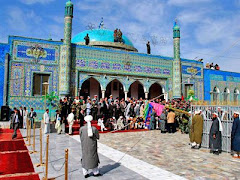
Of course Mazar e Sharif the capital of the northern land, and the home town of the great poet Rumi, is the main city for the celebration of the New Year Fest. Every year at this time, hundreds of thousands of people come to Mazar from different corners of the country, if there is enough security between the cities.. They want to pass the New Year days in this holy city that is believed to host the shrine of Imam Ali, the Shiite’s first Imam and the Sunni’s fourth Caliph who is the only junction point in between the Shiites and Sunni Muslims of Afghanistan.

And of course as said by the people, Mazar is very beautiful in this season, more beautiful than any other seasons of the year; it is beautiful because there are a lot of tulips in the deserts around the city. It is beautiful because many people from different ethnic backgrounds, of different colors and different provinces get together there to raise the flag of the shrine that is called “JANDA BALAA.” They hug each other very sincerely and friendly and forget any kind of animosity and argument they had during the past year, and commit to begin a new year with new plans.

The shrine of Imam Ali in Mazar e Sharif is the shining jewel of the town. The presence of hundreds of white pigeons in this shrine makes it nicer and presence of people at Nowroz make it the nicest.

We should not forget that after Mazar e Sharif, Kabul is the second biggest place for the “JANDA BALA” celebration of NOWROZ. The SAKHI Pilgrimage in the west of Kabul is also believed to be the passage place of Imam Ali and is located mid-way up Asmayee Mountain. On NOROWZ thousands of people gather there to raise the flag of this religious place and celebrate the New Year that is the beginning of the spring.

Let’s not forget about the HAFT SEEN, that means SEVEN and is seven things usually food (fruits or vegetables) that begins with the letter S on the dining table or dining mat on New Years Day. It is also a very important tradition among the Afghans in the Afghan New Year’s Fest.

******

While every one is happy and cheering in fine new clothes on New Year’s Day, I wish I would been able to be there among those white pigeons of Mazar e Sharif and among my family members, friends and my people in this important feast, but I can’t.

The only thing I can do is to say Happy New Year from the core of my heart, to my family members, friends, and all homeland fellows. And to pray for them and for peace in my country so that the year 1387 will be full of prosperity and happiness for everyone in my country, Afghanistan.

HAR ROZ E TAAN NAWROZ NAWROZ E TAAN PEROZ!
“Your every day would be Nowroz and your Nowroz would be prosperous!”

Amen!

Tuesday, March 18, 2008

The images of Afghanistan in Italian class

Just a few days ago our Italian teacher explained that the next class when we have grammar we will study conditional sentences, and she brought some examples.Then she asked the students to give some examples with conditional sentences; almost no one was able to make good sentences, as they had not studied it before, but at least it gave us something to think about.
I went out of the class for a while to think. Then I thought, if my country was safe, what I would be doing now? If I were safe back in Kabul how great would it be then? If there was no more threats, how peaceful and joyful the life would be there? If people were not killed any more how sweet life would be then; if it was secure there, how happy the people would be there? If …… if……. if……..if ……….if …………and many more IFs came to mind, but all related to Afghanistan and its situation.

Fallen into deep thought, I was physically present, but mentally and spiritually I was not in the class. My turn came and the teacher asked me to make a sentence with “if.”

Every one was waiting to hear my sentence. For a while I was not sure what to say, because I had not read it before. On the other hand I was out of the class mentally, so I just took the Italian newspaper that I had in my hand at looked at the pictures. There were pictures on the first page, but I turned the pages to find some more. I saw the image of NATO soldiers patrolling in one of the provinces of Afghanistan and I made my sentence.
“If they leave our country, soon there will be no peace”

“Se loro laciano il nostro paese presto, non ci sara pace”

I could not make this sentence properly but mixed it with English. The teacher corrected it and asked me to make another one. Everyone wondered what I meant, and the students around me rushed to look the picture.

Then I looked for other images in the newspaper and saw there was an image of a Ballistic Missile being carried by a Military crane in a parade, I am not sure where it was, but I made my next sentence:

“ If there were not weapons the world would be safer.”

“Se non ci fossero piu armi il monde sarebbe salvo.”

This time again, the teacher corrected my sentence then turned to another student.

After two or three students when my turn came again, I wanted to see the newspaper again and use some images as examples.

This time the teacher told me not to use it, but use an example outside of the newspaper.
Okay maestra! I said, and started to think a bit. Then I made my other sentence:
“If there were no wars in the world, all humans would live peacefully and equally”

And the teacher corrected my sentence like this: Se no ci fassero guerre nel mondo, tutti gli uomani potrebbero vivere felicemente e equamente

Other students again took their turns, but when mine came again, I said:

“If there were not dangers and threats for me in my country, I would not be here today to speak with you in Italian.”

“Se non ci fossero pericoli e minacce per me nel mio paese, io no sarei qui oggi a parlare con voi in Italiano”

With this sentence every one laughed at me except the teacher, instead I could easily notice a tear in the eyes of the teacher, but she did not want to expose it. Instead she smiled and I knew exactly that she pretends to smile, but she has clearly understood what was going on in the mind of a person escaped from a land of wars and death threats.

And she told me to go out and wash my face. “Amin, go and wash your face and come back. Today you made all of your sentences with sad words and sad objects. Think of some other things too.”

Although she said these sentences happily and pretended to be happy, I could understand from her face what she felt after hearing all these words related to war and destruction, because all of my sentences were all about peace and war, crises, weapons, threats, and life and death as if I had just nothing else in my mind except these kinds of words.

At the end the class when every one left the class the teacher told me to wait, and I waited then she turned on the computer and told me to show her my homeland. I went to Google images and typed Kabul- Afghanistan. Many images appeared and she was looking at them very carefully and anxiously. I had to leave for another class.

The next day when I came to class I saw some photos of Kabul on the teacher’s desk. I think the pervious day she had printed them after I left.

That was how she found out about Afghanistan-- through some words and some images.


Edited and Photo by Robert Maier