Monday, May 28, 2007

An overview of the Afghan Cinema


Cinema in Afghanistan; old enough but not mature yet
(By Mohammad Amin Wahidi)

The most significant changes brought to Afghanistan through transitional peace process during the last five years; are undoubtedly the freedom of speech and free environment for emerging of private television channels and private filmmaking productions.
In renovation of the country, among all, the trend to give more freedom to media as the fourth pillar of government powers has been visible to some extend, although there were challenges and obstacles on the way of this process.

Ariana cinema theatre building reconstructed by the French


Currently there are seven private television channels in Afghanistan

This process has not only been involving the men but simultaneously the women have also been taking a notable part in it.
During the last five years women tend to be seen in different areas including cinema and film industry, working together with the men.
These new changes take place in a situation when a bad image of cinema is introduced to people and cinema is imagined to be a picture of dancing and singing a half naked men and women by the most people which still makes it difficult for women to work in cinema and film industry and appear on screens.


If we turn the page of history as a reference we see that the first professional Afghan feature film by the name of “love and friendship” was made in the year 1946 which shows that cinema has a history of 60 years in Afghanistan but why were we not successful to use it and develop it over years.
Obviously there are many reasons for why cinema is not popular and successful among the people of Afghanistan; low level of literacy, influence of fundamentalist and extremist figures on general opinion, low general knowledge, poor economy, overshadowing of Indian Cinema on Afghans which create a negative image of cinema for the people and lack of governmental support to cinema as a part of cultural reconstruction programs are the main reasons for why the Afghan Cinema has not been successful and popular yet.

The history shows that the first idea of using cinema as an entertainment and as a tool for explaining of the programs of the government to the people in Afghanistan was raised when the progressive king Ghazi Amanullah Khan initiated to build cinema theaters and encouraged theatre plays and film projections beginning with participation of the royal family in the events as part of his social progression programs in picnic places and new built cinema theaters in the 1920s that is why the early generation of our filmmakers and cinema activists have started their work with theatre and then have come to cinema.

Engineer Latif Ahmadi President of Afghan films

The actual idea of developing a film industry in the country has come when the first Afghan feature film was made in the late 1940s by the help of an Indian Studio which was then followed by some other feature films.
After the idea of an actual film industry was raised it took about twenty years until the government moved a step forward and established a department called Afghan Films in the year 1968 by the help of US government with a gap of two decades after production of the first Afghan feature film.

Seddiq Barmak director of Osama

Thereafter, in the 1970s some efforts were made to excel this new born industry but still the general trend was to use cinema as a tool in the hand of government for its own propagandas therefore it was not free and popular.
In the late 1970s some foreign film projects such as Indian and American film projects such as Horsemen 1971 came to Afghanistan which was a really good opportunity for the immature Afghan cinema activists to learn from them and to make future contacts with them.
The government still continued to have cinema in its hand and only supported the films that were in their favor therefore a dependant cinema was born; as a result any changes and problems the government faced it directly effected the cinema and film industry.


Dr. Abdul Wahid Nazari director, former president of Afghan films


Malik Shafeyee famous documentary filmmaker

Atiq Rahimi filmmaker director of Ash and dust

Ali Mohammadi President of Academy of Art and Cinematic Education

On the other hand the cultural and political relations with India opened a path for their films to come to Afghanistan. In these years many youth showed interest to cinema and a few more films were produced by the government supports which are still popular among the people.

In the continuity of these efforts, Afghan private productions such as; Naseer Films, Shafaq Films and Ariana films established slowly on, to make films and train the youth with cinematic techniques which attracted many of youth on that time towards film industry.

1980s are known as the golden years of cinema of Afghanistan when the government already felt the importance of cinema and got advantages from film industry for its purposes on the other hand a few more Indian and western film projects came to Afghanistan while at the same time some short term and long term scholarships in cinema faculty were given to Afghans by India, Russia and some East European countries.

As a result more films were made in the 1980s and it was hoped that Afghan film industry was going to boost thereafter.
But all things changed differently in the early 1990s when the communists were overthrown by the Mujahedeen fighters and filmmaking activities was defined by them as a non Islamic occupation.

They forced hejaab (a special defined covering for women) on actresses and women artists and filmmakers had to flee the country. And the only film produced in this period was Orooj (ascent) a feature film about war of Mujahedeen against the Russians.


Then the civil war began and burnt the body of cinema along with the whole infrastructures of our country.


The two Taliban soldiers
And when the Taliban the extremist force came on power in Afghanistan in 1996, they almost eradicated the art of cinema from Afghanistan by burning a part of Afghan films archive (though a big part of them were hidden by some of the staff), prohibiting filmmaking strictly and charging punishment for filmmaking that was the fiercest behavior with cinema in the history of Afghanistan.


The new era!

Filmmaking in Afghanistan; not an industry yet

Counting the members of private filmmaking productions in Kabul most of which are licensed by the Ministry of Information and Culture we can name Afghan Film Industry Kabuliwood as there are more than 70 small and big filmmaking productions but no significant products are seen in the recent years though there have been keen interest for filmmaking. After the collapse of Taliban, there are only two or three significant real Afghan films produced in Afghanistan which can represent Afghanistan in world wide festival and competitions.


Today if we see the cinematic activities in Afghanistan there are several categories of filmmakers; the generation of 1960s and 70s who are too old to be productive and the second generation is the ones who have studied cinema through scholarships in different countries. The second category has proven to be the most active filmmakers so far as they are trying to experience different films shorts, documentaries and low costs, and the third generation is the young Afghans who do not have knowledge of cinema but they are only fans of cinema and have started their experiential works without an educational cinema background.
The present situation shows that the recent filmmakers of different categories are emerging independently as there is no industry existing in the country but there is still confusion where the Afghan Cinema is going; no one knows.


Significant Afghan Films produced after the Taliban:


Osama a film by Seddiq Barmak after collapse of the Taliban Regime

Osama by Seddiq Barmak and Ash and dust by Atiq Rahimi and Spring of Hope by Hashmat khan are the three 35mm significant Afghan films after the collapse of the Taliban produced in partnership with the foreigners while there have been some independent and partnership foreign film projects from India, France, Iran and other countries in these years which are not counted Afghan film projects.


Women’s presence in arts and cinema:

One of the things that makes us hopeful for the future it is the participation of the women in all arenas including cinema and filmmaking. The women have had a significant presence in cinema and filmmaking in big cities like Kabul, Herat and Mazar-e- sharif despite of all difficulties and problems they have. There are women emerging as directors and actresses and producers.


Women are being obsessive of the five black years of Taliban therefore they have to compensate their backwardness of those years by making different efforts in different arenas of life such as social, cultural, political and economic fields.

Saba Sahar actress, filmmaker and police officer

As a result, profiles like, Marina Gulbahari, Amina Jafari, Saba Sahar, Bereshna Bahar, Aqela Rezayee, Khala Hameda and Zobaida are the women started their career in cinema unprofessionally since the collapse of Taliban and now each of them is trained and grown as an actress and or filmmaker.

Amina Jafari Afghan actress and filmmaker


Marina Gulbahari actress


Aqela Rezayee actress

Playing roles in about 27 short and feature films Amin Jafari has glittered significantly while she has made three documentaries about women and Roya Sadat a student in Law faculty in Heart has shown a great impression by directing her first feature film about the women called Sey Noqta (three dots).

Roya Sadat Afghan Filmmaker director of Sey Noqta

Tuesday, May 8, 2007

Cinema beyond the mountains, among the peaks!



Filmmaking in Daikundi a mountainous province
(By Mohammad Amin Wahidi)

Despite of all problems and difficulties for filmmaking in Afghanistan still there are efforts made in different corners of the country more or less to excel cinematic and filmmaking activities.
Facing different ups and downs the Afghan Cinema is not really paid attention to, by the government and international community as part of the cultural rehabilitation, as it had to, therefore these filmmaking activities are mostly not very well organized and standardized and the recent filmmakers are grown up independently.


(Photo by: Muzzafar Ali)


DaiKundi a province in the central highlands of Afghanistan that has recently served as the location of a film made by a local filmmaker of this province.
The details of the latest film project which is the first ever made film in this mountainous province of central highland (Hazarajat) is reported more in depth by Muzzafar Ali our friend in Dai Kundi.


It is to add that the people of Dai Kundi have expressed their objections in demonstrations against the Indian controversial movie Kabul Express which insulted The Hazaras of Afghanistan faced with vast objections of the Afghans in different countries. As the Afghans showed their broad objections against this movie by numerous demonstrations in Afghanistan and in other countries the Afghan National Assembly condemned this movie and as a result this movie was then banned in Afghanistan by the Ministry of Information and Culture of Afghanistan.


Sarnavisht (Predestination); the first ever movie made in Dai Kundi by a local filmmaker
(By Muzzafar Ali)


General info:
The first movie of the short history of Dai Kundi is almost ready to be released. The movie title is Sarnavisht (Predestination). The mastermind behind this movie is Mr. Laal Muhammad Riffat. The movie, Sarnavisht is planned, written and directed by him. He is from Khedir district. He was also District Field Coordinator in JEMB for Parliamentary Elections during 2005. He then worked as journalist in Radio Dai Kundi for 5 months; during 2006.

He was all alone to invest in the movie, which cost him, 300,000 Afghanis. Most of the money was spent to pay wages to the actors. This movie was made during winter season in Korga Ulya village of Khidir district. The reason for shooting the movie is that the people are almost free to when the villages are snowbound and no cultivation and people are mostly idle. According to Mr. Riffat (as he is from Korgah); he was not present during year of war in the region; people trusted him and he didn’t face any difficulty to mobilize people esp. women to play their roles in the movie. The movie is in pure Hazaragi language (not Dari or Persian) to facilitate local people to understand to message in a better way.

The Movie:
The subject in Sarnavisht is the harms of drug and benefits of education. Mr. Riffat has the role of a school headmaster in the movie. Some of his students get addicted to drug (opium). When the situation gets worse; the headmaster organizes a seminar for local people to enhance public awareness against drug and to mobilize local people against drug usage. The seminar proves decisive and the parents of the drug addicts take actions against their sons. While on opposite side; the gang of drug addicts unifies and considers the seminar against drug against all democratic rules. They are under the impression that; in democracy everyone is free to do what they want and even parents are not allowed to interfere in their activities.
The situation gets worse when parents one-by-one get angry on their addicted sons and they displace their sons from their homes. Now, the gang unified on the mountain and starts theft. When complaints of people mount against the gang; headmaster and students decide to take a decisive action. The students capture the gang members and then police arrest them. One of the gang member escape from the custody of police and dies in cold winter as a result of hunger. The corpse of the addicted person is portrayed as a lesson for other people and here the movie ends.

Producer’s comments:
Mr. Riffat says as he was all alone to produce the movie and invested money; he has finished his money and unable to edit and furnish the raw movie. According to Mr. Riffat; he has no money to travel to Kabul to register the movie in Ministry of Information, Culture and Youth Affairs. He plans to release the movie in Kabul and esp. in Dai Kundi for local people to promote public information against use of drug. In this regard he should distribute the CDs among local community and for massive distribution he doesn’t have enough money to fulfill his ambition.

Although the movie has technically many flaws like, poor picture and sound quality and sudden flow of story in the movie; but overall the movie is impressive and has a great story against opium use. The movie encourages people to send their children to schools and to keep them off from drug and other evil activities. The movie show how can the student play a positive role in a real society when they unify and how they can eradicate culprits among the society. The role of police in the movie is positive as they are cooperative with local people and convey messages to police to have a nice behavior. The movie also promotes the motto of Police for people and People for Police. The most important message for people is to stand and play their roles in society rather than to wait for someone to end the culprits and evil trends.
The movie would promote Dai Kundi culture and local accent of Hazaragi Language on broader basis. The movie is the proof of intense participation of women in every field of life.


Know more about Daikundi Province
(This information is quoted from English Wikipedia website)

Daykundi (Pashto/Persian: دایکندی also spelt Daikondi, Dāykondī or Daikundi) is one of the thirty-four provinces of Afghanistan. It was established March 28, 2004. The region had previously been an isolated district of Uruzgan province.
It is located about 310 kilometers from Kabul and 160 kilometers from Tarin Kowt.
Daykundi's capital is Nili. Daykundi is mostly populated by Hazaras. 7 out of 8 districts of Daykundi province are Hazara populated areas. Gizab is the only district having a Pashtun majority. During past eras the Hazaras of Daykundi have fought with each other. It is reported that in these conflicts approximately 70,000 people have been killed.
Daykundi province is famous for having the best quality almonds, which are distributed all over Afghanistan.
Districts
Gizab
Ishtarlay
Kajran
Khadir
Kiti
Miramor
Nili
Sangi Takht
Shahristan

Sunday, April 22, 2007

Deedenow Cinema receives licences!


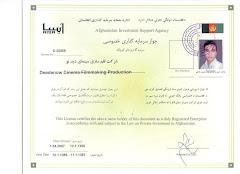
Deedenow Cinema is licensed by the Ministry of Information and Culture and AISA

Licences are recently issued to Deedenow Cinema by Ministry of Information and Culture and Afghanistan Investment Support Agency (AISA) after formal registration in these two organizations.
Licence from AISA


From now on we are announcing our practical activities in the arenas such as; production of films, coordination for international relations of young Afghan Filmmakers, researches in cinema and exchange of Afghan Cinematic experiences with other countries.

Licence form Ministry of Information and Culture

Deedenow which means A New Vision actually is established to have a new vision and new way of thinking on social, civic and cultural issues through lenses of cinema and is a platform for the promotion and expression of young Afghan cinema activists to the world.
The fields we are concentrating our focus in filmmaking activities are as below:

Human rights; women in Afghanistan, children effected by war, minorities
Post conflict situation and
The Hazaras of Afghanistan

When it is entitled to be the Center for International Coordination of Young Afghan Filmmakers, Deedenow cinema is honored to play the role of connecting bridge between the Afghan filmmakers and the filmmakers of the world through bloggers, websites, correspondence, cinema study tour opportunities and international film festivals.


Amin Wahidi Director Deedenow Cinema

Deedenow Cinema is led by Mohammad Amin Wahidi a twenty five years old Afghan Screenplay writer and TV producer who is assisted by his other friends namely, Reza Ahmadi, Hanif Elham, S. Jalal Masoumi, Masoud Zarifi, Ali Akbar Mohebi, Nasim Sahar Ganji and S. Zekeria Rezayee in Deedenow Cinema works.

Poster for “ I am hungry mom!”

This year we plan to produce at least two films; a short fiction and a medium length which are ready to shoot.
The short fiction which is our first actual production was planned to be completed by the end of March 07 but due to lack of needed facilities and resources it has been postponed to the beginning of May.

The second film which is titled “Keys for the Paradise” is a fourty five minutes long screenplay which is also written by Amin Wahidi. For the second project we have the screenplay ready but we are still looking for international producers to produce it or co-produce it with us.

The screenplay “Keys for the paradise” has a very rare story plot and is about the last twenty four hours of life of an Afghan suicide bomber who at the last minutes decides not to blast himself for an imagination he finds.

It is to say that in spite of all problems and obstacles in filmmaking in Afghanistan Amin Wahidi as the director of Deedenow Cinema makes every effort to produce “I am hungry mom!” this year to send it at least to Pusan International Film Festival 2007 and Venice International Film Festival 2007.

We also hope this year we can find producer for our second screenplay “Keys for the Paradise” which has a sensational and controversial plot story that has rarely been written before.

It is worth mentioning that Deedenow Cinema has had a much closed relationship with the Academy of Arts and Cinematic Education and it aims to keep this mutual co-operative relationship continuous in the future too.

Tuesday, March 13, 2007

They are the real ones!

They are the real ones you are interested to know about.

We tell you who to refer for the needs and consultancies of your film projects in Afghanistan:
What are you looking for;
A pool of Afghan filmmakers?
A pool of Afghan screenplay writers?
A pool of Afghan women actresses for your films?
A pool of Afghan men actors for your films?
A bunch of Afghanistan theme screenplays?
And or to know how to process your film projects in Afghanistan or to know about an Afghan filmmaking School?


For all above mentioned you visited the right site. Let us tell you more about an Afghan filmmaking School based in Kabul Afghanistan which responds to all your needs in your film projects in Afghanistan and that is the Academy of Arts and Cinematic Education.
Academy of Arts and Cinematic Education has been reestablished in 2003 by a group of Afghan filmmakers in Kabul Afghanistan.
In the year 2000 it was founded For the first time in Tehran and Isfahan Iran by the name of Rewayat-e- Hejr and after there were pressures and constraints on Afghans in this country, as a result this academy was also forced to give up its activities there so in consequent they returned to their homeland and restructured their organization according to the needs of the new era of Afghanistan and named it what you hear now The Academy of Arts and Cinematic Education.

Having different sub-departments and functional units The Academy of Arts and Cinematic Education aims to promote the cinema of Afghanistan with a deep study of the cultural- social needs of new Afghanistan.


Led by Ali Mohammadi as the President, this Academy has the following organizational structures and functional units:


Central Council members
Public Relations Unit
International Relations Unit
Library with more than 1500 books
A pool of plot writers and screenplay writers
A training center for incarnation and dramatic arts courses


In the present situation of Afghanistan when there is no focus of attention on cinema by the government, while there is need of taking serious steps on cultural reconstruction the most important one of which is cinema, The Academy of Arts and Cinematic Education is the only organization in the country level that conducts filmmaking courses, cinematic researches, film projection and critics events and produces films of fiction and documentary kinds independently.
Of course we have bigger institutions in the country such as Fine Arts Faculty of Kabul University, which is entitled to be the biggest center for the dramatic arts in Afghanistan, Afghan Films which is a governmental department licensed by the ministry of information and culture for filmmaking and cinematic activities, Filmmakers Union of Afghanistan and other institutions with big titles on them but perhaps none of them have been able yet to be useful and provide cultural artistic services as the Academy of Arts and Cinematic Education does.


The courses of different fields of filmmaking such as digital cinematography or film shooting, screenplay writing skills, films editing and acting held by the Academy of Arts and Cinematic Education have been very effective for the Afghan youth and the new generation who passed most of their lives in the war or in exile.
And now as a result the students graduated from the Academy of Arts and Cinematic Education, are independent filmmakers or have been employed by the private television channels in the country which brings boasts and prides for the founder and President Ali Mohammadi and his working team.

Ali Mohammadi the founder and the President of the Academy of Arts has started his artistic career with calligraphy and then continued with graphic and then completed with cinema in a university in Tehran Iran while living in immigration there.
Since he has known himself and recognized his role and responsibilities in the society he has committed to work for humanity and serve for his people thus he has gathered a group of other committed people of the same as himself to support him in the great mission of cultural reconstruction in Afghanistan.
And now we believe that Afghanistan is a country that is linked and related some how with the countries of international community as we get better the world gets better and as we suffer it again does affect the global village.
Then we are to announce that we are ready for cooperation and sound relationships with any one and any organization in any country of the world that has the same thoughts and views as we do. That’s why we think internationally with an open minded view about our homeland and the global village.
And finally if you have the same thoughts and views as we do then we are friends from now on.
Let’s shake hands of friendship and let’s help each other out in the obstacles and constraints that we have in our cinematic activities.
We again emphasize that contact us for any kind of helps and consultancy on your film projects in Afghanistan.
Yes you have visited the right site.
Keep in touch with us.

Monday, February 19, 2007

Does anyone hear our voices


Does anyone hear our voices?
Young Afghan Filmmakers need your supports!

Deedenow Cinema, a private production of young Afghan Filmmakers, established to shape and present an independent artistic cinema in Afghanistan.

Women, children, religious and ethnic minorities and victims of human rights violation in Afghanistan are the main themes and subjects of our filmmaking activities.

We focus on independence of cinema from any kind of pressure, influences, partisan and misusage to keep an independent artistic cinema in Afghanistan.

We are the youth, we know that we have a long way ahead, but fortunately or unfortunately we live in a stage of time, when there is need of doing something for.

We want to play a great role in the transitional period of our history when new and unaccustomed words are heard in our terminology but not understood, said but not applied.

We are not only living in the era of requirements and challenges of the new millennium but as an Afghan society with more complicated cultural – social ad tribal challenges of our own specific types.

The words democracy, human rights, justice, progress, prosperity are the terminologies which the Afghans are not familiar with but only have heard about.

In this way, there is need of many kinds of tools and mediums to brighten the minds the best of which is cinema; comprehensive and popular to bring great changes.

In the era of technology when the sky is easily touched, why can’t the hearts be caught?
Thus our motto is “Wanna catch the hearts!” based on which we want to connect our people with the world through our independent artistic cinema but with new way of looking at things therefore we have chosen the name, Deedenow which means New Vision in Dari language.

We believe that cinema is the third eye for human beings, thus things are seen differently through it, how ever our efforts are to show the others how things seem to us.

One part or one side of our activities are our people and our country but the other part which is a decoder of our messages to whom we have to communicate our message, our vision, and the way how we see things in the world, is the viewers and target audiences and is finally you.

Thus relying on the proverb, “the friend in need is the friend indeed” we have chosen you as a friend to open our heart before , saying that; do you hear our voices? Young Afghan filmmakers need your supports!

You have read our views and heard our voices, it now depends on you whether you do what you can do for us as a friend or not.


What we expect you to do for us is only:

Join us to see things through our lenses.

Visit our weblogs on daily basis to know about Afghan Cinema and filmmakers.

Send this address to your friends interested in Afghan Cinema.

Introduce us to the film festivals, film productions and film schools of your country.

Introduce our products in your hometown and homeland.

Give your comments on the articles and contents of our weblog.

Link us to your websites and weblogs.

Keep in touch with us on frequent basis.

Co-produce the screenplays we have ready to shoot if you can.

And if you can;

Kindly donate us new and or your second hand filmmaking equipments such as second hand digital photography and video cameras, tripods, lights, booms, camera lenses and filters, and any extra equipment that you have for the promotion of Afghan Independent Artistic Cinema.

Be ever green but don’t forget to visit us again!

How an independent cinema forms

How an independent cinema forms

Since its birth in the late nineteenth century by The Lumiers, the cinema has gradually evolved in different shapes and forms.
By passing time, the cinema emerged to have the strongest and the most expensive essence; as a mixture of arts and technology.

Movies were first made to pass time and bring smiles and cheers to the people’s faces while they became the strongest mean to express one’s vision and feelings of his surroundings to the others as time passed, thus cinema became a tool for different purpose thereafter.

During the war times, the cinema could play the role of a tool of the campaign for the parties in conflict and is used for political propagandas of regimes.

When there is peace, the cinema could be a good entertainer, a good source of income, a good encoder of messages and a good conformity for possibility of any thing in the world. And again it depends on how it has been used which still depending on specific main factors which have direct influences on it; the thoughts and opinions of filmmaker from his surroundings, the targeted audiences and economy.

Cinema in its age of more than a century has had trends in different directions but predictions and foreseeing have always been main characteristics of it in all decades of its history.

There are filmmakers who make films of their dreams and imaginations and on the other hand there are filmmakers who in every step of filmmaking activities consider the target audiences choices and satisfaction, therefore they rely very much on economy and box- office. The economy which is a huge and necessary supporter of the cinema has a great influence on it in different ways which is obviously seen in the outcomes of the cinematic products.

There are, how ever, filmmakers in all decades of the age of cinema, who think independently and make what and how they think, they don’t care about what the others think about what they do and how the economy plays role in their work, they are only fond of cinema hating following the footpaths of the others thus they are all the time, seen to be moving opposite the mainstreams.

They are curious and tired of the normality and usuality thus they often think differently, and the others call them independent filmmakers, how ever their films are more specific audiences oriented.

It is not that they make films of what they dream or imagine about but in fact they make films of how differently they see the world thus they chose the cinema as their third eye.
Looking for one of those who think differently who believe they should influence their surroundings not the surroundings would influence them, but finally we found that;

We ourselves are one of them, thinking independently and making what we think.
This is how an independent cinema forms!

Wednesday, February 14, 2007

There we go!


Poster for " I am hungry mom!"


Soon we are full hands with the first actual production of Deedenow Cinema “I am hungry mom!”

“I am hungry mom!” is the title of short fiction which is the first actual production of Deedenow Cinema after its establishment. The screenplay is written by Mohammad Amin Wahidi and soon it will be directed by him in March 2007. The screenplay after being completed by Amin Wahidi has been reviewed and certified by Academy of Arts and Cinematic Studies in Kabul who will technically support the production of this short film. “ I am hungry mom!” which at the beginning titled “Homa” as the name of its main character, is about a small girl who is looking for treasures in the ruin buildings of Kabul after hearing the tales of treasures form her mother. It will be filmed in Kabul and poverty, hunger, ruins and the war affected children are focused on in this short film.

It is to say that after completio,n this film will be sent to the national and international film festivals.

Film information:

Film title: I am hungry mom!
Subject: Explore of a seven year old Afghan girl, who is looking for the treasures in the ruin houses in Afghanistan based on the legend she has heard from her sick mother that “treasures are in the ruins”.
Screenplay writer: Mohammad Amin Wahidi
Director: Mohammad Amin Wahidi
Length: 20 minutes
Format: digital
Language: Dari (Persian)
Subtitle: English
Producer: Deed-e-now Cinema Production
Production year: 2007
Status: pre- production

I am hungry mom!
(The story of a curious little girl in the ruins of Afghanistan)


Synopsis:

Homa is a seven / eight year old Afghan girl who lives with her mother and her brother. Her father has been disappeared during the Taliban regime and they know nothing about him since then. Half a day Homa goes to school and half a day she weaves carpet at home with Homayoon her brother. Carpet is the only income for their livelihood though her mother is infected with tuberculosis because of weaving carpet for years and years.
At nights her mother tells her different tales and legends and hearing them Homa goes to sleep. One night her mother tells her the legend of the poor boy and the treasure an ancient traditional tale. After she hears this legend from her sick mother, she decides to look for and find out the treasures in the ruins of her home town.

Finally she faces with different things that bring her memories of the years of war and Taliban regime when she finds different old and broken items from the ruin houses and buildings each of which is the symbols of different mementos and different stories.


Why this subject?!

Afghanistan is a country that has been under the focus of different counties of international community and foreign aids and this focus has been very widely spreaded out in the media and press of the world after the disaster of September 11th 2001. From the eye of a filmmaker the very important part of the focus of international community in this country is the very bottom layer of the society, or the hungry bare feet people of the citizens of the country. How these aids have affected the lives of these low class citizens of the society it is very important.

Despite of all these aids, reconstructions and propagandas there are still people looking for their daily food, there are still people dying of hunger and very dangerous diseases they faced with because of poverty and there are under age children still being forced to work to feed the families who have lost their guardian in the civil war and there are still ruined house across the country even the capital city of the country, Kabul. And there still four things that are very obvious even for a foreign visitor to this country and they are: Poverty, hunger, ruins and orphan children who beg or work on the roads.

As per the geological surveys being conducted in this country, the available underground minds and minerals are enough at least to feed the people and to help them in their livelihood, but when they all be extracted and be used for the well of the poor citizens god knows!

This is a question of young and old people of Afghanistan that where do these foreign aids go? How will this aids and assistances affect the lives of poor people of Afghanistan? In this story Homa a seven year old girl who has lost her father during the Taliban, is exploring the ruins of her country looking for treasures as has heard a legend from her sick mother about it; “The treasures are in the ruins”. Then she faces with some other realities and truths!


After this short film “Keys of the Paradise” is the second screenplay which is also written by Mohammad Amin Wahidi will be produced by Deed-e- now Cinema Production and that is about an Afghan suicide bomber who at the last minutes decides not to suicide himself. The Keys of the paradise depicts the last 24 hours of life of an Afghan suicide bomber Mullah who in the last minute decides no to suicide himself for some humanitarian visions and imaginations he founds.

Wish success for the interested productions / individuals who want to invest on such projects in Afghanistan in the future.